The Polite Verb Switch: A Three-Spoke Café Wheel for Orders That Don't Sound Like Demands
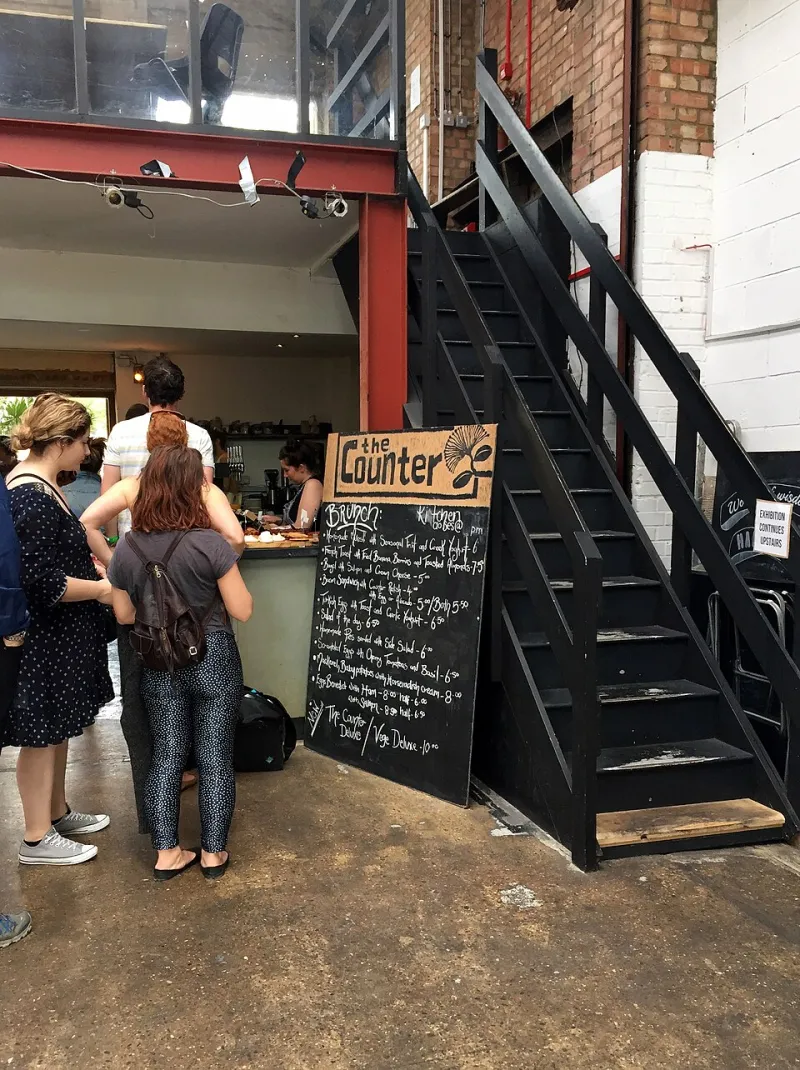
Photo: Bex Walton from London, England, CC BY 2.0, via Wikimedia Commons
You can rehearse the vocabulary on the bus. You can picture the pastry. You can even remember whether the café takes card. Then the queue shuffles forward, the barista looks up, and out comes the same sentence you learned in Year 8: I want a coffee. In English it sounds a bit blunt. In French, Spanish or German it can sound even blunter, because the verb you have chosen is doing the heavy lifting — and it is the wrong verb for the job.
This is not really a phrasebook problem. It is a verb-pattern problem. Politeness in a café is not a sprinkle of please on top of a demand. It is a different spoke on the wheel.
Why I want barges in first
I want is the sentence that arrives under pressure because it is simple, direct and easy to retrieve. It sits in the present tense, states a fact about your desire and stops. In a UK café we soften the same idea without thinking: Could I get a tea, please?, Sorry, would it be possible to have..., I'll grab a.... We are not translating those words from English into French, Spanish or German. We are performing a social move — and the target language performs it with a different verb form.
The trap is that the direct present tense is often grammatically correct. Je veux un café is not a crime against conjugation. Quiero un café is understandable. Ich will einen Kaffee will get you caffeine. But understandable is not the same as comfortable. In a shop or café, the direct want-form can land like a finger jab at the counter. The polite forms do not just add manners; they change the relationship between speaker, listener and request.
Meet the three-spoke café wheel
Picture a small wheel with the pronoun at the centre and three spokes around it. This is the VerbWheel version of a café order: not a list of phrases to memorise, but a switch between three jobs.
| Spoke | Job | French (je) | Spanish (yo) | German (ich) |
|---|---|---|---|---|
| Want | states desire | je veux | quiero | ich will |
| Like | softens the request | je voudrais | me gustaría / quisiera | ich möchte / ich hätte gern |
| Could I have? | asks availability or permission | pourrais-je avoir | ¿podría tener? / ¿me pone? | könnte ich ... haben? |
The wheel matters because it keeps the three jobs separate. If you learn them as a phrasebook stack, they blur. If you learn them as spokes, you can feel the shift: same speaker, same noun, different social gear. The noun does not change. The verb does.
For a UK learner, the most useful spoke is usually the middle one. Je voudrais is the conditional of vouloir, not the present. Me gustaría is the conditional pattern around gustar. Ich hätte gern uses the conditional of haben. These forms are not decorative. They are the grammar of a request that leaves room for the other person to answer.
The conditional is the polite gear
This is where the wheel earns its keep. A lot of learners know that je voudrais means I would like and still treat it as a fixed phrase. But on the wheel, it is a gear change. You are moving from a present-tense statement to a conditional one. French conditional endings turn up across the spoke: je voudrais, j'aimerais, je pourrais. Spanish conditional patterns do the same job: me gustaría, podría, querría. German uses modal and conditional shapes: ich möchte, ich hätte gern, könnte ich.
That is why adding please to a blunt verb does not quite fix the sound. In English, I want a coffee, please is still a bit direct. In French, je veux un café, s'il vous plaît has the same mismatch. The please is polite; the verb is still in the wrong gear. The wheel trains you to change the verb first, then add the courtesy.
A five-minute counter drill for the kitchen table
You do not need a Parisian café or a Berlin bakery to practise this. You need five minutes, three slips of paper and a pretend counter. Put a mug, a biscuit and a glass on the table. The mug is the counter. You are the customer. The wall is the barista.
Start with one language and one spoke at a time. Sixty seconds on want: order the mug, the biscuit and the glass using je veux, quiero or ich will. Say them out loud. Notice how flat they feel. Then sixty seconds on like: je voudrais, me gustaría, ich hätte gern. Then sixty seconds on could I have?: pourrais-je avoir, ¿podría tener?, könnte ich ... haben?. The point is not to be perfect. The point is to feel the switch in your mouth before the queue is real.
Next, mix the spokes. Shuffle the three objects. Pick one at random. Spin the wheel in your head and order it using the middle spoke. Then do it again with the third spoke. If you freeze, drop back to the middle spoke — it is the workhorse for cafés, shops and market stalls.
Make it feel like a UK counter
A useful role-play is the one you already know: the Pret queue at 8:40am, the local high street café with a chalkboard, the Greggs counter where the person in front is ordering for four people. Set a timer for two minutes and act out the whole exchange, not just your line. The barista says Bonjour, Hola or Guten Tag. You order. They ask if you want milk, a bag, a receipt. You answer. Then you swap roles and say the barista's lines yourself.
This matters because the counter is not a single sentence. It is a sequence. The polite spoke has to survive the follow-up question. If you have only memorised je voudrais un café, you can still stall when the reply comes back at speed. If you have practised the wheel, you can rotate: Oui, avec du lait, s'il vous plaît; Sí, con leche; Ja, mit Milch, bitte.
What to listen for
When the polite form lands, the reply often changes. You may hear Bien sûr, Claro or Natürlich. You may hear a more formal vous or a casual tu in French, depending on the café. You may hear the staff member mirror your conditional back at you. That is the signal that the verb did its social work. You are no longer stating a want at someone. You are making a request they can accept.
The three-spoke café wheel is deliberately small. It fits in the same mental pocket as your bank card. Want, like, could I have. Present, conditional, modal question. Same noun, different gear. Five minutes before you leave the house is enough to stop I want from being the first thing through the door — and enough to make I'd like the sentence that reaches the counter first.